What is a "hot roof" and why do I need it?
A “hot” or “warm roof” is an effective method for insulating a house, increasing energy efficiency, and creating a favorable microclimate in all living spaces. This technology involves insulating the roof and all attic walls. This helps to retain heat or coolness in the building’s space, thus reducing electricity bills.

Installing a "hot roof": what does it mean?
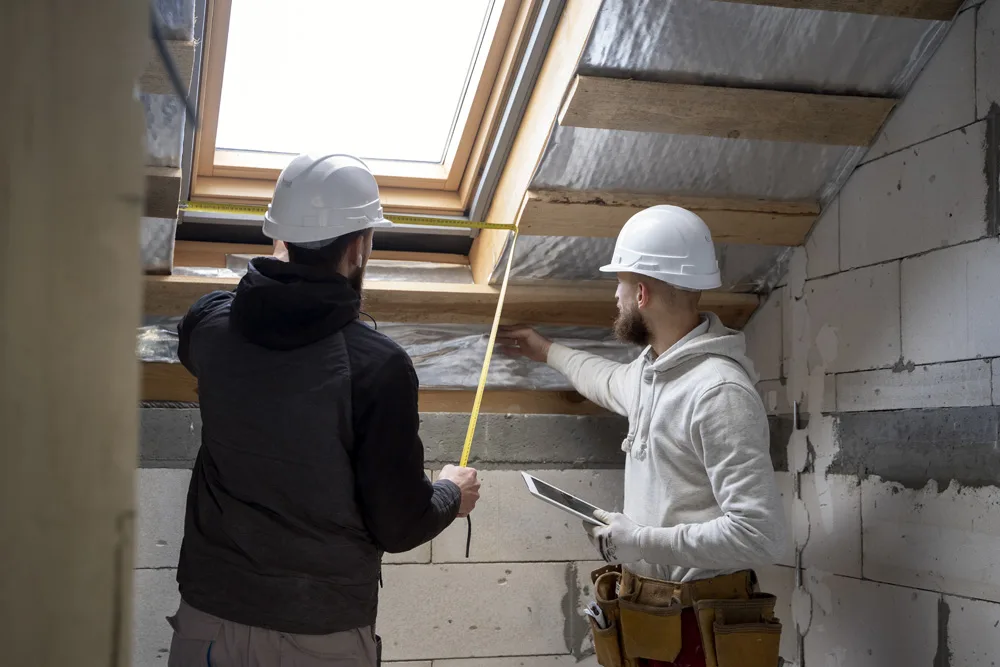
Before installing a “hot roof,” testing is carried out using a blower. This helps determine the intensity of air leakage before insulation is installed. Essentially, a “warm roof” seals the top of the house, isolating it from the external environment and preventing the “chimney effect,” where warm air masses rise, making the temperature in living rooms uneven.
Important! The old insulation is removed as it can be a source of insects, mold, and rodent droppings – all of which are toxic to health, spoil the air, and cause poisoning.
The process begins with laying a special membrane. It forms a moisture-protection barrier against dampness and mold, and also holds cellulose insulation in place. Then, fire-resistant, eco-friendly cellulose is blown behind the membrane as close to the attic eaves as possible. This prevents the formation of ice dams.
Fact! When your attic turns into a “hot roof,” it will cool the house in the summer and warm it in the winter. You’ll pay less for cooling or heating.
Which is more economical: hot or cold roofs?
For the construction of a non-ventilated roof, spray foam insulation is used. Additionally, vapor barriers and air barriers are installed to protect against drastic weather changes. All this requires expenses, but it makes the attic suitable for living and prevents the loss of conditioned air.
A “cold” (ventilated) roof is the standard solution. In this case, the attic is not part of the cooled or heated space of the building. The attic has floor insulation that separates the air between the upper living areas of the house. This type of roof requires ventilation openings – at the gable, ridge, and soffits. Ventilation partitions are also essential.
Which is more economical? The ventilated roof helps to maintain coolness in the summer and reduces air conditioning costs. In winter, it prevents the attic space from heating up from the living rooms (which prevents the formation of ice dams, which are difficult and expensive to remove). The non-ventilated structure makes the attic livable and prevents conditioned air from escaping the building. However, the installation of such a roof is more expensive.
Which option is more energy-efficient?
It all depends on the climate. A “cold roof” with ventilation prevents ice buildup in winter and keeps the attic cool in the summer. For high energy efficiency, the attic space needs to be sealed and prevent external air from entering the conditioned space (this mixing causes the heating, cooling, and ventilation systems to work more intensively).
Usually, the temperature in a non-ventilated attic is the same as in the rest of the building. However, this depends on the insulation’s heat transfer resistance coefficient. This affects the energy efficiency of the entire structure. In the summer, the attic may become warmer since insulation allows heat to pass through. In the winter, the attic under a “hot roof” will also be warmer.

Advantages of installing a hot roof
The benefits of this technical solution include:
- Reducing electricity costs
- Protection against ice dams
- Elimination of drafts by sealing the top of the house
- Increased comfort in living spaces – neutralizing temperature differences of 10 degrees
- Possibility of converting the attic for living purposes
- More efficient operation of air conditioning
- Improved durability of ventilation, heating, and air conditioning systems
Advantages of an air-conditioned attic
If the attic is air-conditioned by air from the living space, it provides the following benefits:
- No need for additional insulation
- The attic can be used for installing ventilation ducts, electrical cables, pipes
- It’s permissible to store things in the attic (provided the rafter system can bear such loads)
- It’s possible to install air ducts to address the issue of air overcooling or overheating, and to prevent the passage of air from outside
- Ice dams do not form
Useful tip
If ventilation, heating, and air conditioning systems work in a room that isn’t conditioned, it’s like installing equipment outside the house. But with a “hot roof,” everything functions within the conditioned space. Therefore, it operates less intensively, and the house maintains coolness in the summer or warmth in the winter.
Interesting fact
By choosing cellulose insulation, you show concern for the environment and help preserve the planet for future generations. How? By reducing carbon dioxide emissions and reducing energy consumption.

Q&A
Do I still need to seal all holes in the attic floor?
Yes, such holes need to be sealed to prevent air leakage and to prevent fire from entering during a fire.
What about SIPS?
The rules for such panels are similar to those for foam materials. However, since SIPS have a thickness of 12 inches, their heat transfer resistance is higher. The panels are fixed with screws to the beams and can be installed without a 6-inch limitation. To determine whether to use SIPS, consult specialists.
Do I need the same amount of insulation?
It depends on the region’s climate. The heat resistance of the attic should be R30, R38, or R49, depending on the climate zone. The IECC 2009 standard allows exceptions. This is an alternative U-factor or a reduced option for northern areas. In the latter case, the insulation is placed outside the upper panel.
Conclusion
Specialists from Roofing & Siding in Cape Cod will tell you more about this technology and help implement it in your home to increase its energy efficiency.